
Are you walking your dog or is your dog walking you? That’s the question I posed last week, and I am pretty sure many of you chose the latter, maybe even hiding your face in embarrassment.
I am here to tell you that you are not alone and it doesn’t have to be this way forever! This post will give you all the things you need to know to teach your dog to be a polite walker.
But before we begin, you may want to first understand the difference between polite leash walking and heel walking explained in the first part of this series.
Done? Now you and our dog are ready to start training!
Things your dog needs to master before training to walk on-leash
1. Eye contact
Teach your dog to give you eye contact both voluntarily and when you cue him to by using rewards.
Start by training him to do this in a calm, familiar environment, and then progressing to more interesting surroundings.
Remember, there is no point in practicing leash walking with your dog in an environment where he doesn’t routinely and frequently look at you.
If you find that he is too distracted, move to a quieter, more familiar area.
2. Staying relaxed outdoors
Teach your dog to remain relaxed when he is out with you. You will best achieve this by:
– Taking your dog out regularly, at least 2-3 times a day
– Exposing your dog to many different environments and people
– Stopping and waiting until your puppy calms down, and insist on him checking in with you before you continue walking
– Keep outings, including meeting people and other dogs, as low key and matter of fact as possible
Equipment to bring out with you
The right equipment for leash walking is crucial to your success.
Your dog should be wearing a front leading harness (e.g. Perfect Fit, SoftTouch Sense-ation, LoriStevens Balance Harness, BlackDog Balance Harness, and Premier EzyWalk) and a flat collar. Your leash should be at least 120cm long.
If your dog is over 25-30 kg and pulls heavily, I would recommend first getting professional help to teach him to enjoy wearing a head halter (e.g. Gentle Leader) for his and your own safety.
You will also need a safe place to keep his rewards. Ideally, use a quick snap treat pouch, which is convenient and clean. It is also crucial that you use a reward he really loves.
Please note: choke chains and prong collars aren’t only ineffective in teaching your dog not to pull, they are also dangerous because they hurt your dog and can cause lasting health and behavioral problems.
How to teach your dog polite leash walking
The following rules apply at all times and you should follow them consistently for your dog to master polite leash and heel walking. The attached video (apologies for the quality) will help you understand the rules better.
1. Never tighten the leash
Handlers often unconsciously tighten the leash, which unfortunately teaches their dogs that pressure around the neck is a cue for them to pull harder and go faster.
It may help to use a long leash that you can securely attach to your waist. This prevents your arm from thoughtlessly tightening the leash, while keeping your dog safe.
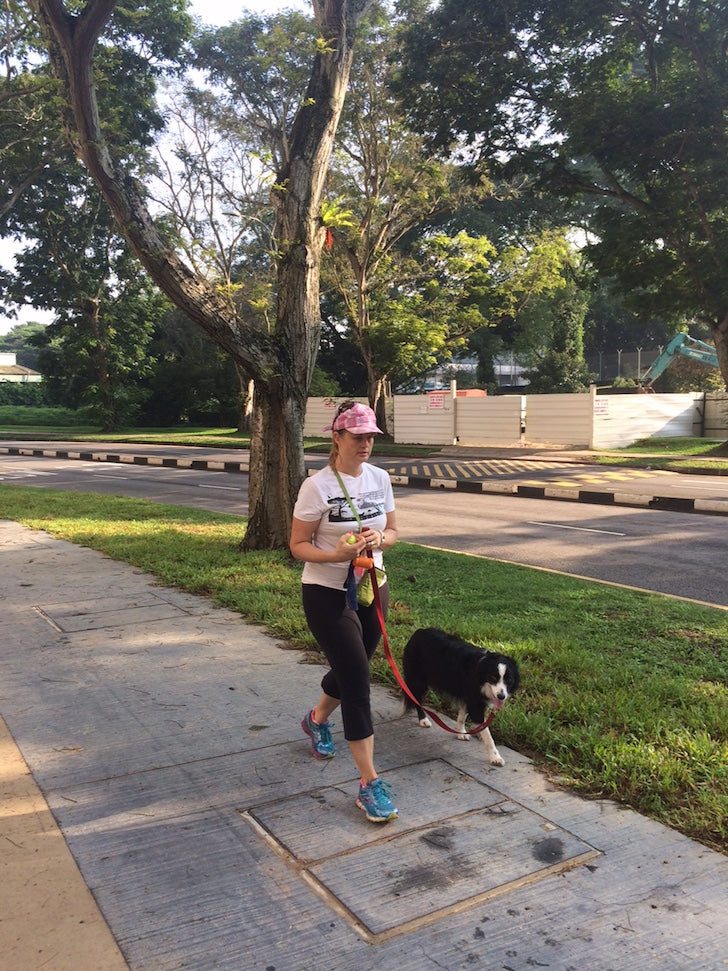
There are only two situations when you may need to tighten the leash:
– When preventing your dog from crossing to the other side of you
– When your dog is not checking in or looking at you at all. Stop moving and shorten the leash to make the situation really boring (no sniffing around or walking). Once your dog looks at you, immediately loosen the leash and walk again
Never yank or pull on the leash, Instead, use the leash to create a boundary and block access.
Also, be aware that if you have to deal with these situations often, it is likely that the environment you are walking in has too many distractions for your dog’s current skill level.
2. Never start walking unless your dog has looked at you first
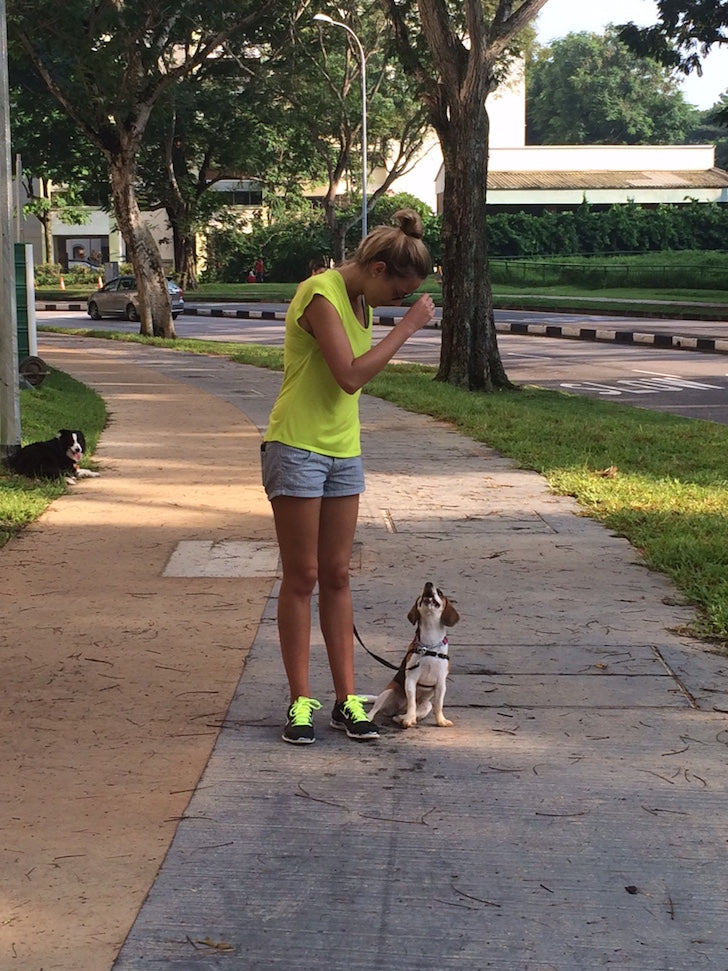
If your dog doesn’t look at you after a minute, even when you reduce his access area by shortening the leash, you need to move to a less distracting and easier environment and practice more eye contact.
3. Only walk if the leash is slack
If your dog pulls on the leash, immediately stop and wait for your dog to check in with you and reposition himself so that the leash is loose again. In other words, your dog should be backing up or turning back towards you, so that the leash is slack before you are ready to go again.
4. Never let your dog pull you to get to something he is interested in

Whether it’s to go to other dogs, to greet people, or to sniff something, always ensure that your dog stops and checks with you (to ask permission) before you let him do so. Even after checking in, make sure that arriving at the desired spot happens while the leash is kept loose.
5. Start with the desired side
Always start with your dog on the desired side of you and reposition him to the correct side if he tries to cross over.
6. There’s no need for a verbal cue
I have never used a verbal cue for my dog’s polite leash walking. The fact that the leash is attached is a signal to your dog that polite lead walking is required at all times. This works for me because I have never let my dog pull me.
7. Take it slow
Only increase the difficulty and distractions of your walk when your dog has mastered walking politely within a more familiar and less distracting environment.
Final advice
When you start using a leash, it is crucial that you keep it slack at all times. Remember, you can safely secure the leash to your waist or body if you find that your hand involuntarily tightens the moment you hold the leash.
Leash walking is very complex to teach. This is mainly due to the many aspects that you have to consider while you have your dog on a leash (e.g. speed, where your dog is, what your hand/arm is doing, distractions, and more).
Also, there are some pre-requisites before you can start teaching him, namely, eye contact and calmness when out.
Furthermore, it is a hands-on task for both you and your dog. The experience of reading about it and practicing it for real may be completely different.
Hence, don’t hesitate to consult a positive reinforcement trainer or behaviourist who can greatly help get you and your dog on the right track.
This is especially so if you are worried about your dog’s behaviour or when you feel the training is not progressing.
Ensure that the help you seek is 100% force- and pain-free and based on scientific methods.
This is to ensure maximum effectiveness of your training, to reduce possible unwanted side effects (e.g. stress and aggression) and to increase the enjoyment for both you and your dog.
Don’t miss the last part of our “Mastering the Walk” series:
Part 3: How to teach your dog to heel
Subscribe to be updated when the next part is published.
Photo credits: Softouch Concepts, inc. and Sangudo via Source / CC BY-NC-ND


