
Does crate training look complicated and time-consuming to you? The truth is, crate training your puppy or even your adult dog can be a breeze if you start right.
I have seen many puppies who were contented to sleep in their own crate with the door shut on their first night home. On the other hand, I have also come across puppies who were traumatised by poor quality confinement training.
For this reason, I urge you to follow the guide below before leaving your puppy in the crate. Rehabilitating a traumatised puppy will be much harder than spending the effort of getting it right in the first place.

The speed of crate training and how you introduce your puppy to a crate depends on how your puppy feels about the crate. This can be affected by many factors, which include:
1. His upbringing at the breeder:
- Did he spend time in the crate with his mother?
- Was he slowly introduced to confinement training?
- Was crate training a part of his everyday routine since birth?
2. Your puppy’s natural demeanour – Is he reasonably relaxed and not easily stressed or frustrated?
3. How your puppy feels about being left alone
Factors that could cause a negative association to the crate:
1. Was your puppy flown to you in a crate?
- Being away from his siblings and confined for the first time in a noisy environment would naturally be traumatising. Many puppies who experienced this are prone to confinement anxieties in the long run
2. Has your puppy learned that crying gets him out of the crate?
3. Does your puppy have tendencies of being “hyper-attached”?
- E.g. Your puppy struggles and becomes unhappy when you walk away from him
4. Some puppies panic if they can’t get away
- These puppies may settle well in a crate when the door open, but not when the door is shut
5. The age of your puppy
- Has your puppy been enjoying weeks of freedom, roaming around freely? If so, he may get frustrated when that freedom is reduced
Due to these varying factors, there isn’t a one-size-fits-all approach for all puppies. You will have to work within your puppy’s comfort level.
One thing is for certain – You can’t just throw your puppy in the crate and expect him to adjust to the new routine and environment. That would be traumatising to anyone.
Early positive association is extremely important:
1. Make it comfy
- Lay a nice crate pad and an old folded towel or blanket in the crate
- Tip: don’t use an expensive bed unless you are okay with it being ruined by pee or excessive chewing
2. Keep it close
- Place the crate in a high traffic area like the living area. The more company your puppy gets, the better
3. Make it rewarding
- Whenever your puppy isn’t looking, drop a couple of high-value treats at the back of the crate. Don’t point these out to him – let him discover them on his own
- Feed him meals in there, and if possible, do so using interactive toys like those from KONG
- Tie an attractive stuffed chew toy to the rear of the crate using a durable string so that your puppy must lie inside the crate to chew on it
Understand your dog’s comfort level:

Below are three tests you should take to gauge your puppy’s comfort level with a crate before you start crate training. Do not shut him in a crate before you have completed the tests and the recommended exercises found in this and the next part of the series.
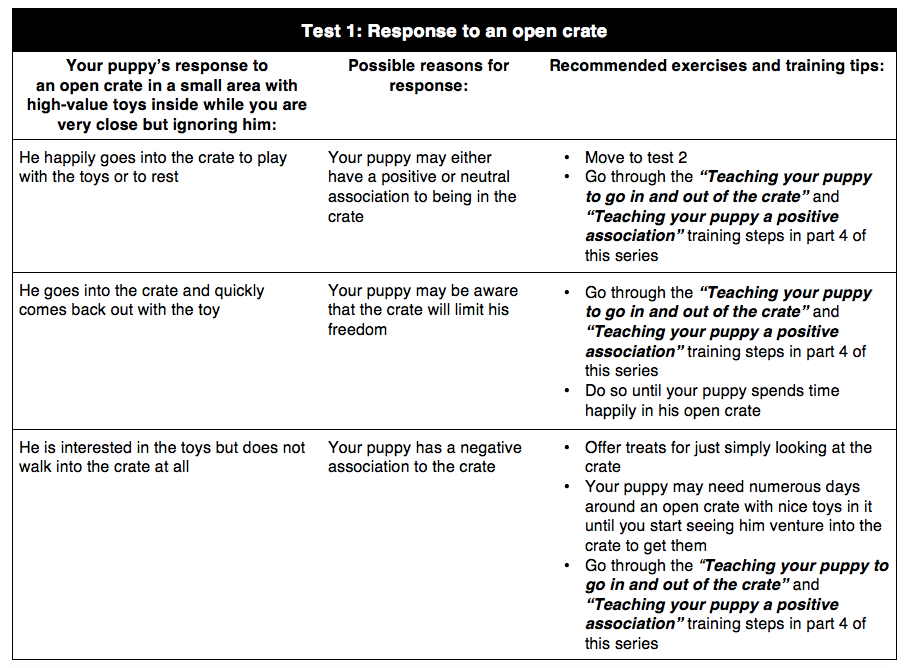
Test 1: Response to an open crate
This test will assess your puppy’s current emotional response to the crate and to small and dark confined areas. Place the crate with the door open in a small area of your house, and put a couple of high-value toys or chewing items (e.g. KONG, pig’s ear, deer antler etc.) in the crate after showing them to your puppy. Ignore him but stay with him and watch.
[Click to enlarge]
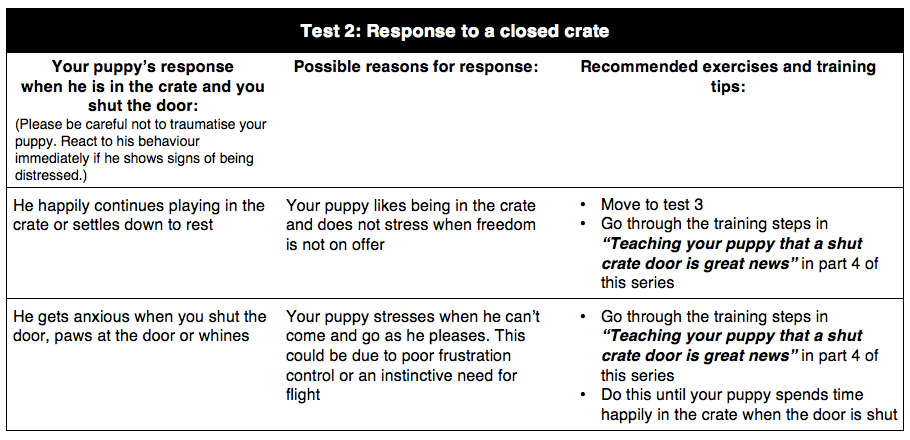
Test 2: Response to a closed crate
This test will assess your puppy’s response to the crate door being shut. Some puppies may panic or become stressed when the crate door is shut. In such cases, it is important to ensure that a closed crate door is paired with good things during training.
[Click to enlarge]
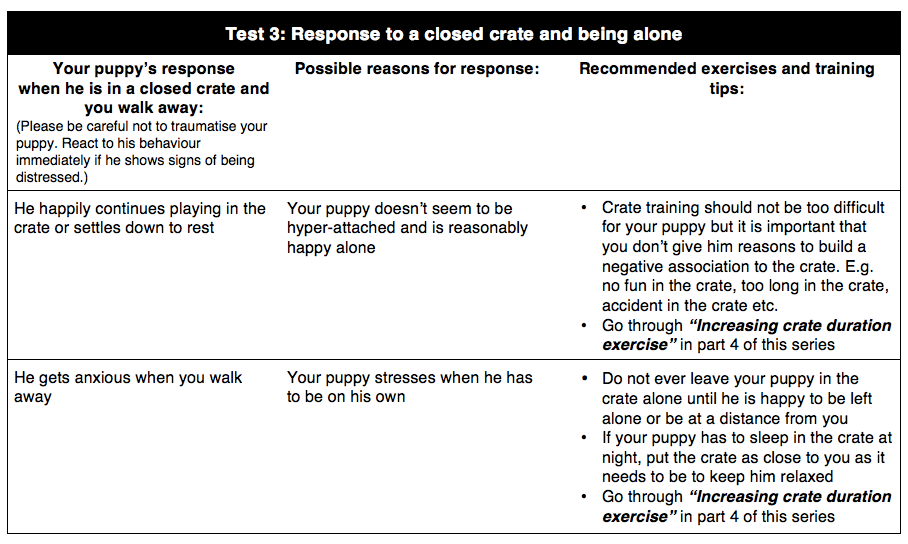
Test 3: Response to being in a crate and alone
This is to test for hyper-attachment. Some puppies become stressed not because they are in the crate but because they are left alone.
These puppies will often form a negative association to the crate as it becomes a predictor of alone time.
It is crucial that you realise it when your puppy has this problem. If you don’t address the issue, it would only cause the problem to worsen and your puppy may grow up with severe separation issue.
[Click to enlarge]
Read other parts of our crate training series:
1: What is crate training and why you should do it
2: How to choose a suitable dog crate
4: Crate training your dog the right way
Subscribe to be updated when part 4 is published.
Please read: important rules for responsible confinement training

Your dog should never be confined for many hours at once. Slowly increase the amount of time your dog spends in a crate to a maximum of 5-6 hours a day.
1. Balance confinement with freedom
All dogs need mental and physical stimulation and companionship. If you are teaching your dog to be in a crate at certain times of the day, you need to make sure he also gets daily walks, playtime, time to run free and time with you.
2. Keep your dog close
When using a confinement area for long-term management, it is important that this area is close to the family – exposing the dog to experiences with us. Confinement training involves including your dog in family life and not excluding him from social companionship.
3. It’s about fun, not punishment
Confinement always needs to be fun (give things for entertainment), never punishment.
The aim of confinement training early on in training is to prevent your dog from learning bad habits and to teach him to be comfortable being confined when necessary. As your dog’s behaviour gets more trustworthy you can then allow him more freedom.
Photo credit: recompose via Foter.com / CC BY-NC-ND


